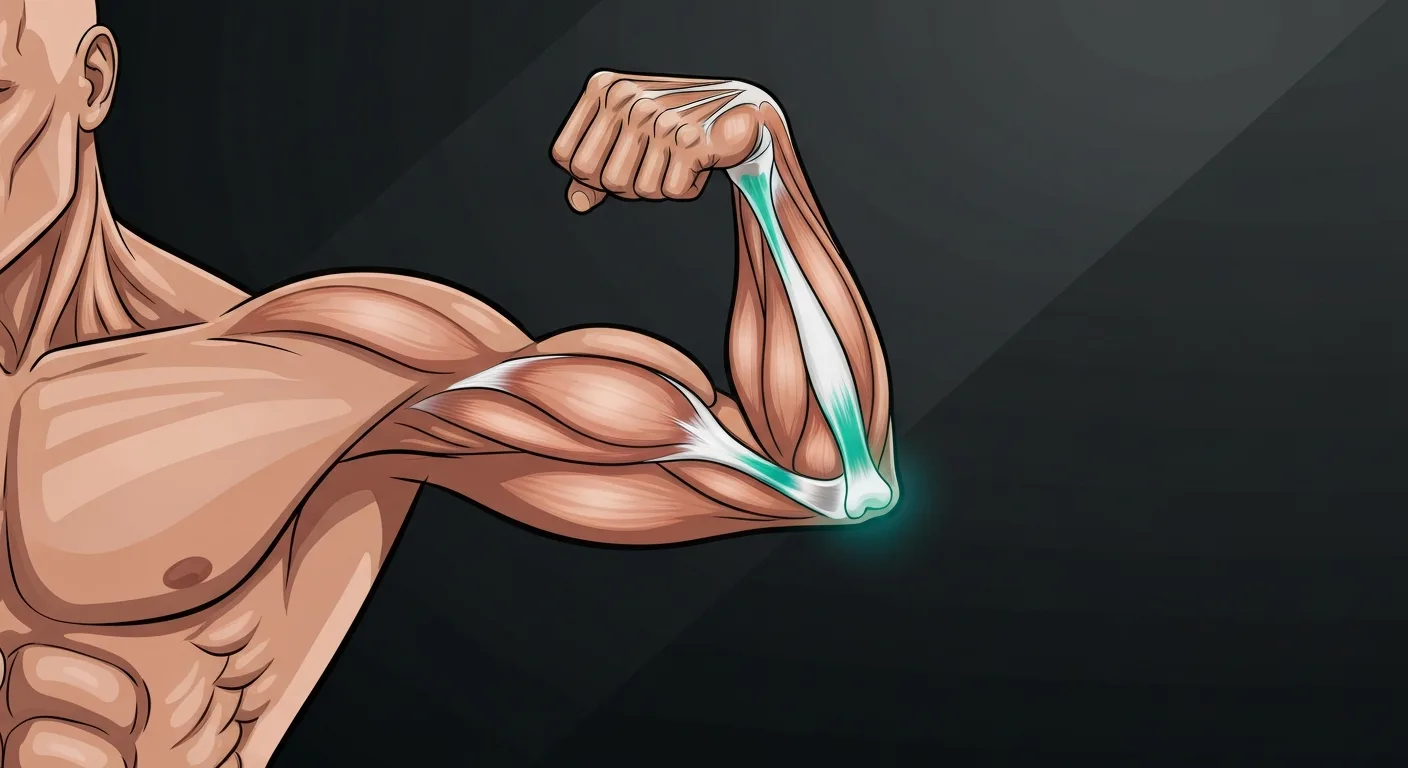
Tricep pulses are short-range, rapid partial contractions performed at or near the lockout position of a tricep exercise. They create intense metabolic stress and muscle burn, complementing the mechanical tension from traditional full-range exercises. Use them as finishers after your main tricep work.
What Are Tricep Pulses?
Pulses are small, controlled movements — typically 2 to 4 inches of range — performed rapidly at the most contracted portion of an exercise. Unlike full-range reps that train the triceps through their entire length-tension curve, pulses keep the muscle in constant contraction, restricting blood flow and creating intense metabolic accumulation.
This metabolic stress is one of three recognized mechanisms of muscle growth (alongside mechanical tension and muscle damage). Pulses are not better than full-range exercises — they provide a different stimulus that can complement your primary training.
How to Do Tricep Pulses
Kickback Pulses
Hinge at the hip, extend your arm back to full lockout (as in a kickback). From the fully extended position, lower 2 to 3 inches and pulse back to lockout rapidly. Maintain the contraction — never let the arm drop below the pulse range. 20 to 30 pulses per set.
Pushdown Pulses
Perform a cable pushdown to full lockout. Release only 2 to 3 inches, then pulse back to lockout. The cable provides constant tension that makes pushdown pulses particularly effective. Use bands for a similar effect at home.
Overhead Extension Pulses
At the top of an overhead extension, pulse through a short range near full lockout. This targets the long head with constant tension in its shortened position.
Push-Up Pulses
At the top of a diamond push-up, lower only 3 to 4 inches and pulse back up. Great for home workouts and as a burnout finisher.
How to Program Pulses
Use pulses as a finisher — the last 2 to 3 sets of your tricep session after all full-range work is complete. A simple approach: perform your last set of any exercise to near failure with full range of motion, then immediately transition to pulses for 15 to 30 seconds. This extended set technique maximizes metabolic stress.
Do not replace full-range exercises with pulses. The lateral head, medial head, and long head all need full-range training for complete development. Pulses are a supplement, not a substitute.
Who Benefits Most from Pulses
Beginners building the mind-muscle connection — pulses teach you to feel the tricep working. Home trainees with limited weight — pulses make light weights feel much harder. People returning from injury using light loads. Advanced lifters looking for additional metabolic stimulus beyond their standard high-volume training.
If your triceps feel disproportionately underdeveloped, see our guide on why your triceps may be weak for structural causes and solutions beyond pulse techniques.