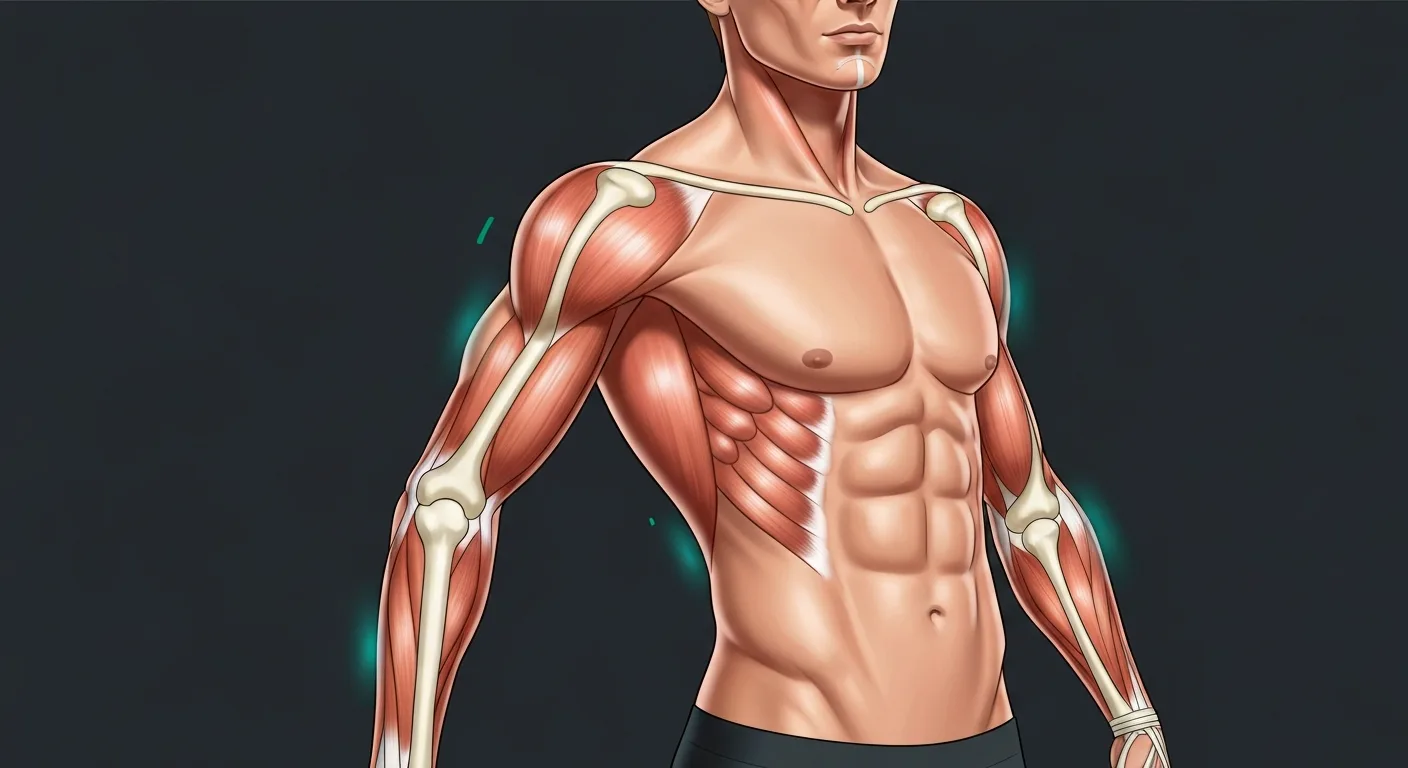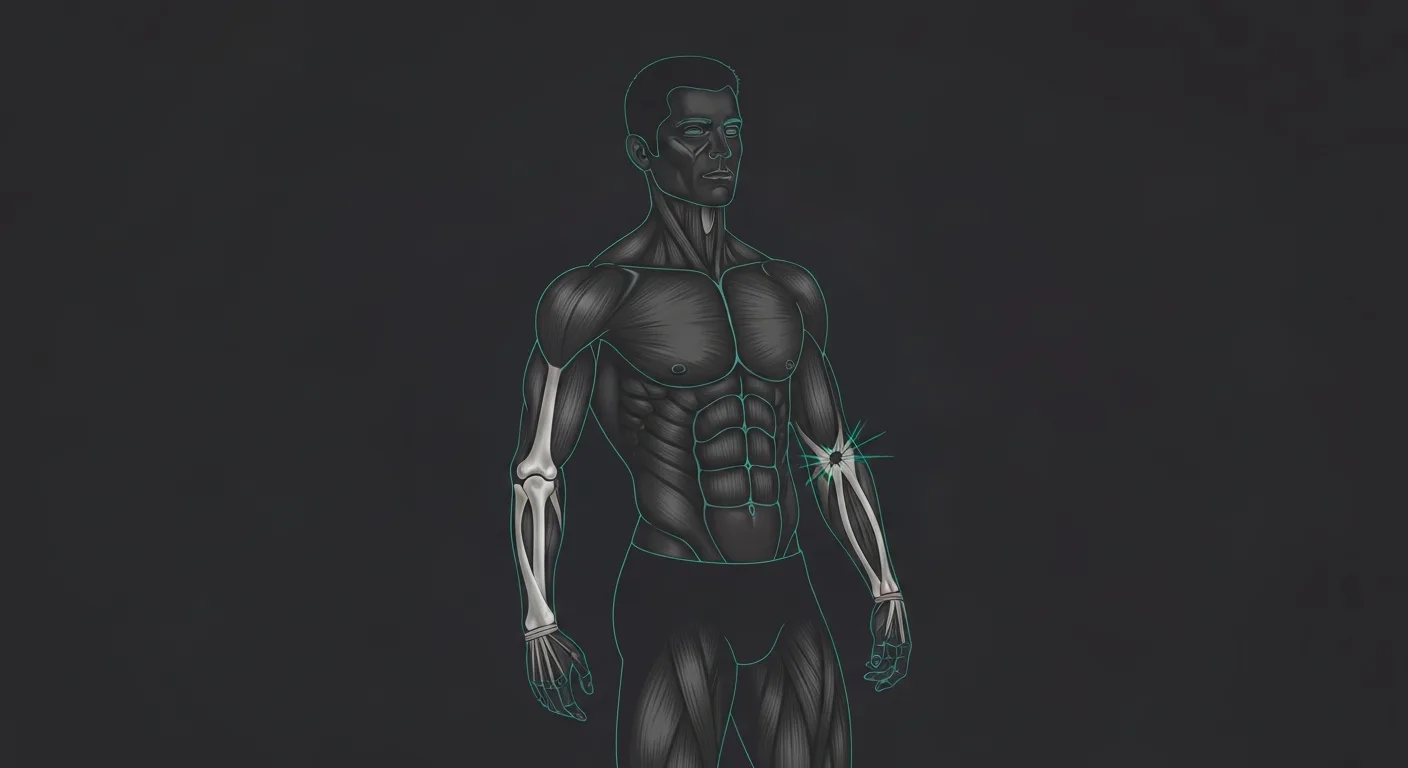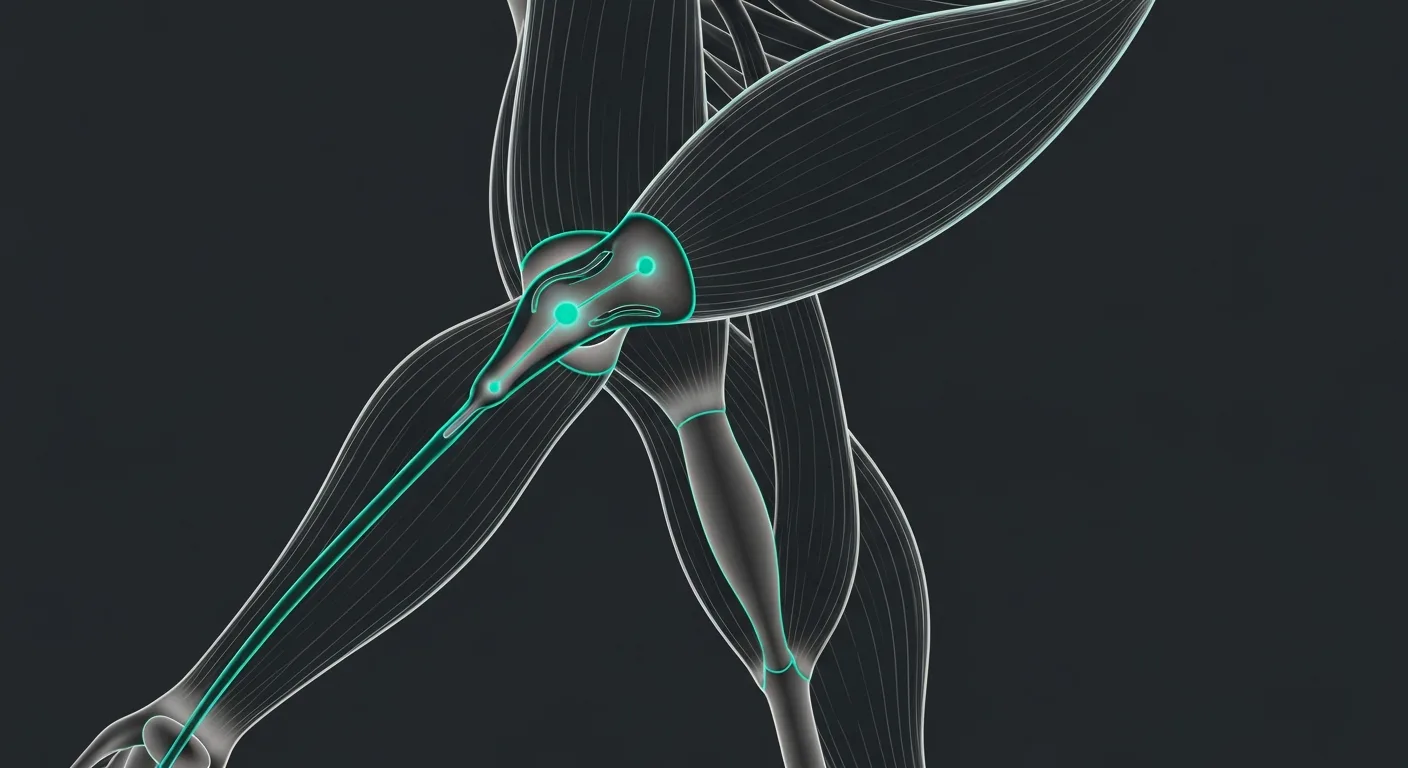
Tricep strain symptoms include sudden pain at the back of the upper arm, swelling, weakness when extending the elbow, and tenderness to touch. Strains are graded from 1 (mild fiber stretching) to 3 (complete rupture). Recovery ranges from 1 to 3 weeks for grade 1 to several months for grade 3 injuries requiring surgical repair.
What Is a Tricep Strain?
A tricep strain is an injury to the muscle fibers or muscle-tendon junction of the triceps brachii. It occurs when the muscle is stretched beyond its capacity or loaded with a force that exceeds its tolerance. The term "strain" specifically refers to injury to muscle or tendon tissue, distinguishing it from a "sprain" which involves ligaments.
Strains can occur in any of the three heads of the tricep but are most common at the muscle-tendon junction near the elbow or in the long head near the shoulder. The location and severity determine both symptoms and recovery timeline.
The Strain Grading System
Grade 1: Mild Strain
Grade 1 involves microscopic tearing of muscle fibers with no significant structural damage. You can still use the arm, though it may feel tight and mildly painful. Strength loss is minimal — usually less than 10 percent. Swelling may be present but is often barely noticeable.
This is what most people call a pulled tricep. It is the most common form of tricep strain and usually resolves within 1 to 3 weeks.
Grade 2: Moderate Strain
Grade 2 involves partial tearing of a significant portion of muscle fibers. Pain is moderate to severe, and you will notice clear weakness when trying to straighten the arm against resistance. Swelling is visible, and bruising often develops within 24 to 48 hours. A "pulling" or "tearing" sensation may be felt during the injury.
Grade 2 strains require 4 to 8 weeks of recovery, with careful progressive loading to restore strength without re-injury.
Grade 3: Complete Tear / Rupture
Grade 3 is a complete tear through the muscle belly or tendon. It presents with severe pain, immediate and significant weakness (inability to extend the elbow against resistance), often an audible pop or snap, substantial swelling and bruising, and sometimes a visible gap or bunching of the muscle.
Grade 3 strains — particularly complete tendon ruptures — almost always require surgical repair followed by 4 to 6 months of rehabilitation.
Symptoms by Grade
| Symptom | Grade 1 | Grade 2 | Grade 3 |
|---|---|---|---|
| Pain | Mild, during activity | Moderate to severe | Severe, often constant |
| Swelling | Minimal | Moderate | Significant |
| Bruising | Rare | Common (24–48 hrs) | Extensive |
| Strength loss | <10% | 20–50% | Near-complete |
| Pop/snap felt | No | Sometimes | Often |
| Palpable gap | No | Occasionally | Yes (if tendon) |
| Recovery | 1–3 weeks | 4–8 weeks | 4–6 months (surgery) |
Causes of Tricep Strains
Tricep strains typically occur from eccentric overload (lowering a weight the muscle cannot control), sudden forceful extension (throwing, punching, pushing), falls onto an outstretched arm, direct impact to the back of the arm, and training with excessive volume or intensity beyond your current capacity.
Risk factors include insufficient warm-up, fatigue from overtraining, age-related tendon stiffening (over 35), previous tricep injuries, and muscle imbalances between the triceps and biceps.
Treatment by Grade
Grade 1 Treatment
Rest from aggravating activities for 3 to 7 days. Apply ice for 15 to 20 minutes several times daily. Begin gentle range-of-motion exercises within 2 to 3 days. Start light resistance band exercises when pain allows. Return to normal training within 2 to 4 weeks with gradual loading.
Grade 2 Treatment
Rest the arm for 1 to 2 weeks. Ice and compress during the acute phase. Consider medical evaluation with ultrasound to confirm the extent of tearing. Begin rehabilitation at 2 to 3 weeks with isometrics, progressing to light concentric exercises. Use a support brace during early return to activity. Full return to heavy training at 6 to 10 weeks.
Grade 3 Treatment
Seek immediate medical attention. Imaging (MRI) is necessary to plan surgical repair. Post-surgical rehabilitation follows a structured protocol over 4 to 6 months. Do not attempt to manage a grade 3 strain at home — delayed treatment leads to worse outcomes.
Rehabilitation Principles
Successful strain rehabilitation follows a progressive loading approach:
- Early phase — pain management, gentle motion, isometric holds.
- Mid phase — light concentric and eccentric exercises. Stretching to restore flexibility. Bodyweight tricep exercises are excellent here.
- Late phase — progressive resistance training, sport-specific movements, return to full loading.
Do not skip the eccentric loading phase — controlled lowering exercises (like slow overhead extensions) are one of the best-studied interventions for building back tendon and muscle resilience after a strain.
Resistance Bands for Rehab
Progressive resistance for strain rehabilitation.
Why we suggest it: Smooth tension ideal for rebuilding strength after a strain.
Check Price on Amazon →As an Amazon Associate, we earn from qualifying purchases.
Strain vs. Tendonitis vs. DOMS
A strain is an acute injury with a clear onset — you usually know the moment it happened. Tendonitis is a chronic overuse condition that develops gradually, localized to the tendon at the elbow. DOMS is normal post-exercise soreness without structural damage. If you are unsure which you have, the key question is: did the pain start suddenly during a specific activity, or did it build up over days?
When to See a Doctor
Seek professional evaluation if pain is severe or sudden-onset, you felt a pop or snap, visible bruising develops, you cannot extend the arm against any resistance, or symptoms do not improve within one week. Early diagnosis and treatment — especially for grade 2 and 3 strains — lead to better outcomes and faster return to activity.