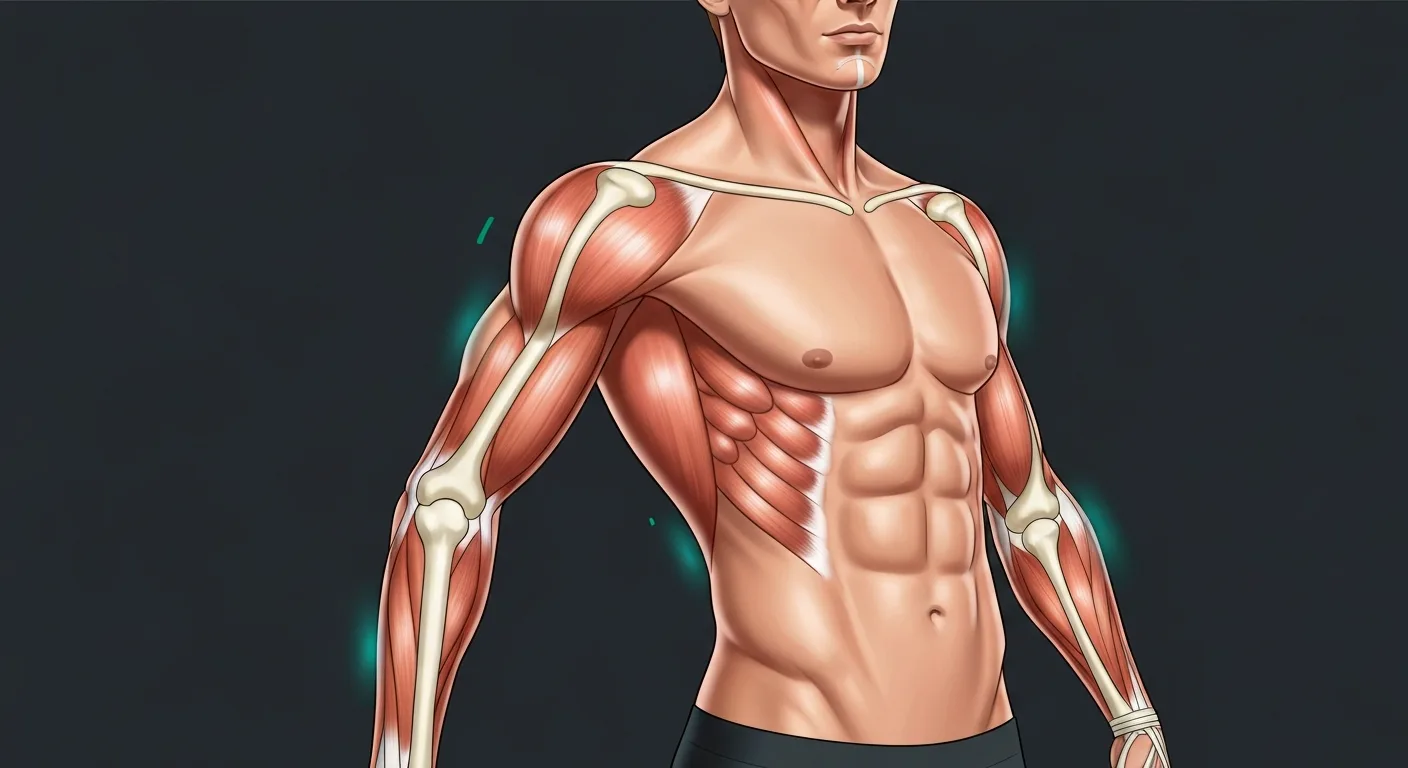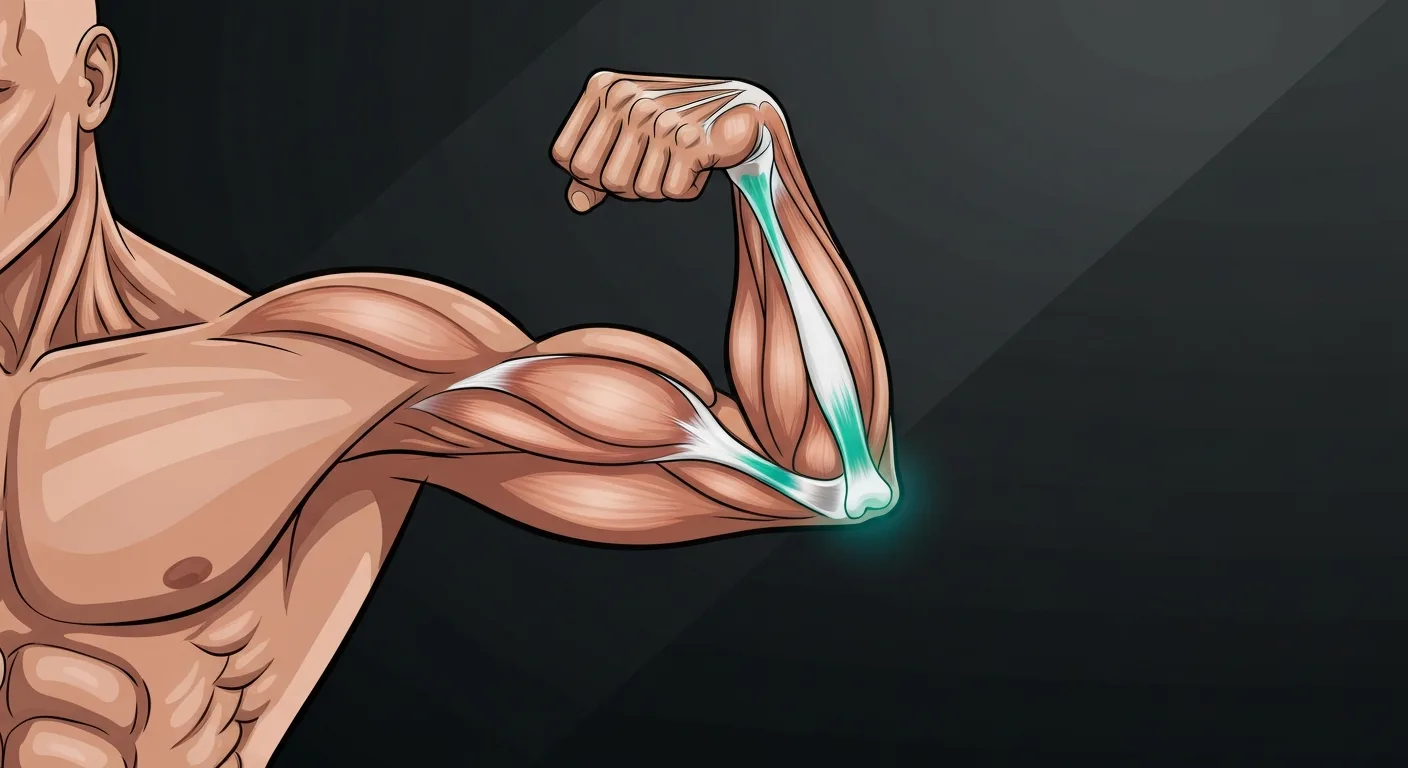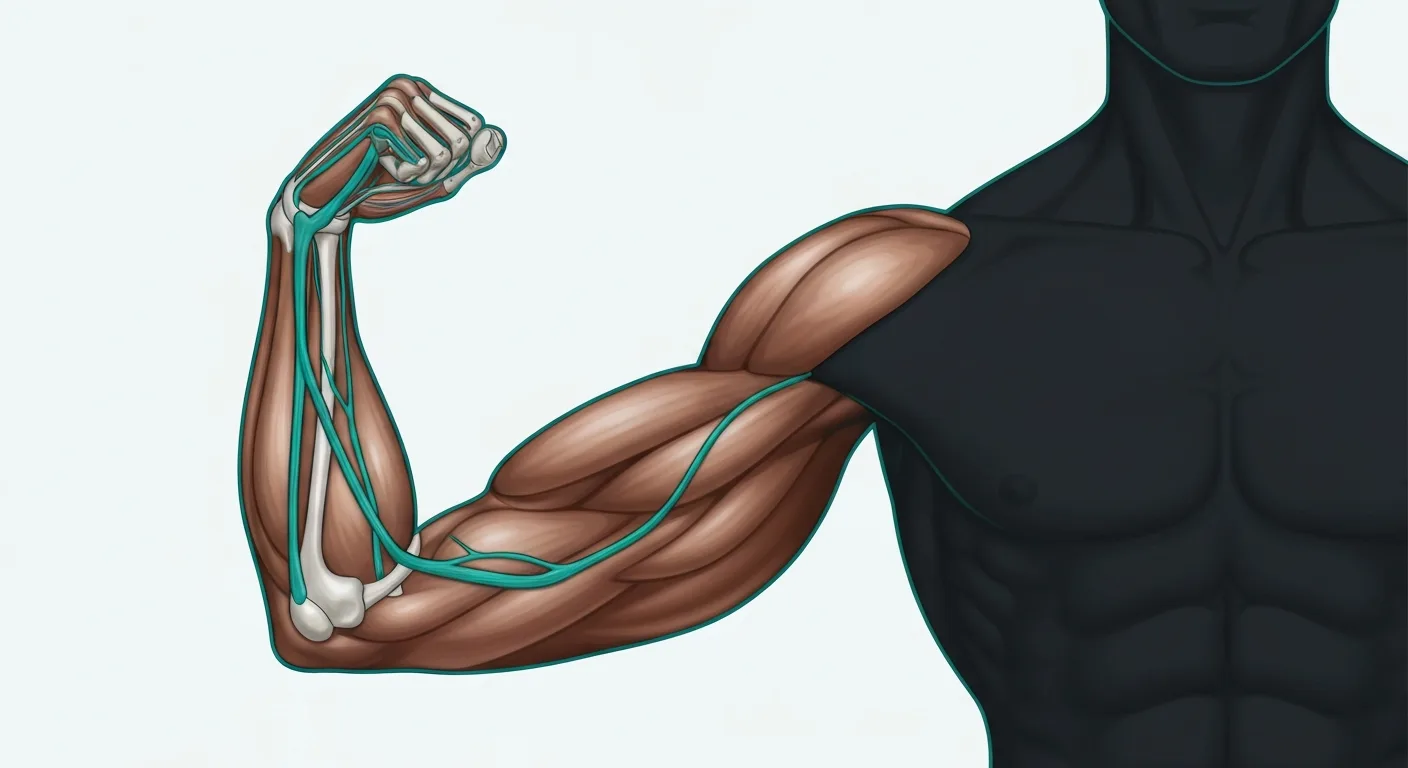
The arm contains four muscles in the upper arm and roughly 20 muscles in the forearm. The primary upper arm muscles are the triceps brachii (back of the arm), the biceps brachii (front), the brachialis (deep front), and the coracobrachialis (inner arm). The forearm muscles are divided into flexor and extensor compartments that control the wrist, hand, and fingers.
Upper Arm Muscles: Overview
The upper arm — the region between the shoulder and elbow — is divided into two compartments by a layer of deep fascia called the intermuscular septum:
- Anterior compartment (front of the arm): biceps brachii, brachialis, coracobrachialis
- Posterior compartment (back of the arm): triceps brachii
These four muscles work in pairs. The anterior muscles flex (bend) the elbow, while the triceps extends (straightens) it. Understanding this antagonist relationship is key to balanced training and injury prevention — see our detailed explanation in are triceps or biceps stronger.
Triceps Brachii
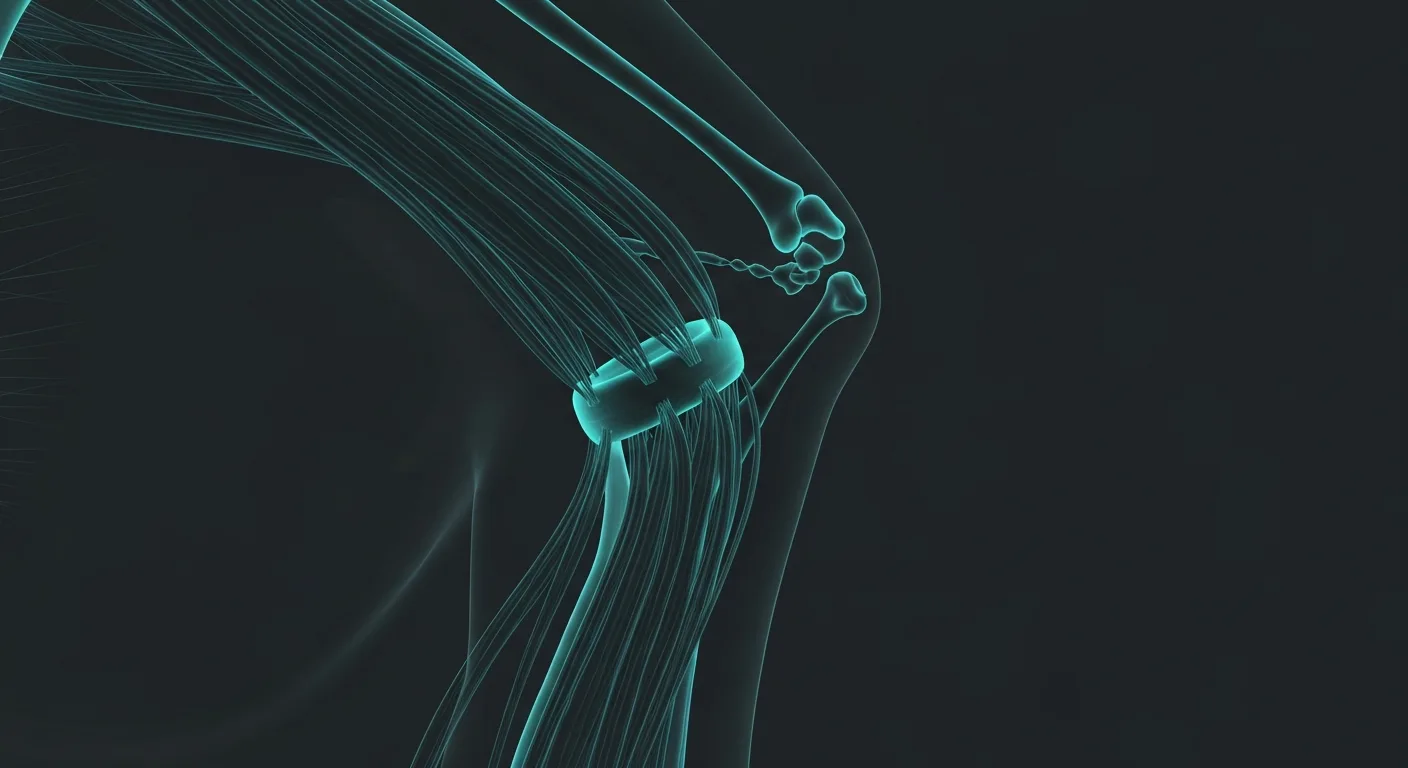
The triceps brachii is the largest muscle in the upper arm, making up approximately 60 to 65 percent of total upper arm mass. It has three heads — the long head, lateral head, and medial head — that converge on a single tendon at the elbow.
| Feature | Details |
|---|---|
| Location | Posterior upper arm |
| Origin | Long head: scapula (infraglenoid tubercle). Lateral head: posterior humerus (above radial groove). Medial head: posterior humerus (below radial groove) |
| Insertion | Olecranon process of the ulna |
| Nerve | Radial nerve (C6–C8) |
| Primary Action | Elbow extension |
| Secondary Actions | Shoulder extension and adduction (long head only) |
The triceps is active in every pushing and pressing movement — bench press, overhead press, push-ups, dips — and is the prime mover in all tricep extension variations. For a ranked breakdown of the most effective movements, see our best tricep exercises guide.
Biceps Brachii
The biceps brachii sits on the front of the upper arm and is the most recognized arm muscle. Despite its fame, it is significantly smaller than the triceps.
| Feature | Details |
|---|---|
| Location | Anterior upper arm |
| Origin | Short head: coracoid process of the scapula. Long head: supraglenoid tubercle of the scapula |
| Insertion | Radial tuberosity and bicipital aponeurosis |
| Nerve | Musculocutaneous nerve (C5–C6) |
| Primary Actions | Elbow flexion and forearm supination (turning palm upward) |
| Secondary Action | Shoulder flexion (weak) |
The biceps has two heads: the long head (outer) and the short head (inner). Both cross the shoulder joint, but forearm supination (turning the palm upward during a curl) is the movement that activates the biceps most distinctively. When the forearm is pronated (palm down), the brachialis and brachioradialis take over much of the elbow flexion work.
Brachialis
The brachialis is an often-overlooked muscle that sits deep to the biceps on the front of the upper arm. Despite its lower profile, it is the strongest pure elbow flexor — even stronger than the biceps at this specific task.
| Feature | Details |
|---|---|
| Location | Deep anterior upper arm (beneath biceps) |
| Origin | Anterior surface of the distal humerus |
| Insertion | Coronoid process and tuberosity of the ulna |
| Nerve | Musculocutaneous nerve (C5–C6), with lateral portion by radial nerve |
| Primary Action | Elbow flexion (pure flexor — not affected by forearm rotation) |
Because the brachialis inserts on the ulna (which does not rotate), it is equally effective as an elbow flexor regardless of whether the forearm is supinated, pronated, or neutral. This is why hammer curls (neutral grip) are excellent for brachialis development — they reduce biceps contribution and force the brachialis to do more work.
A well-developed brachialis pushes the biceps upward and outward, making the upper arm appear thicker from the front. If your arms look flat despite consistent biceps training, under-developed brachialis muscles may be the reason.
Coracobrachialis
The coracobrachialis is the smallest and least known of the upper arm muscles. It runs along the inner aspect of the arm, mostly hidden beneath the biceps.
| Feature | Details |
|---|---|
| Location | Medial (inner) upper arm |
| Origin | Coracoid process of the scapula |
| Insertion | Medial surface of the mid-humerus |
| Nerve | Musculocutaneous nerve (C5–C7) |
| Primary Actions | Shoulder flexion and adduction |
The coracobrachialis does not cross the elbow, so it plays no role in elbow flexion or extension. Its primary function is helping to lift the arm forward (flexion) and bring it across the body (adduction). It is trained indirectly during front raises, chest presses, and any movement that involves shoulder flexion against resistance.
Forearm Muscles: Overview
The forearm contains roughly 20 muscles divided into anterior (flexor) and posterior (extensor) compartments. These muscles control wrist movement, grip strength, and finger dexterity.
Anterior Compartment (Flexor Side)
The anterior forearm muscles are arranged in three layers — superficial, intermediate, and deep. Most originate from the medial epicondyle of the humerus (the bony bump on the inner elbow). Key muscles include:
- Pronator teres — pronates the forearm (turns palm down) and assists in elbow flexion.
- Flexor carpi radialis — flexes and abducts the wrist (bends wrist toward palm, tilts toward thumb side).
- Flexor carpi ulnaris — flexes and adducts the wrist (bends wrist toward palm, tilts toward pinky side).
- Palmaris longus — a weak wrist flexor that tenses the palmar fascia. Absent in about 14 percent of people — its absence has no functional consequence.
- Flexor digitorum superficialis — flexes the middle joints (PIP) of the four fingers.
- Flexor digitorum profundus — flexes the tips (DIP) of the four fingers. This is the muscle that gives you a strong grip.
- Flexor pollicis longus — flexes the thumb tip.
- Pronator quadratus — deepest forearm muscle, pronates the forearm.
Posterior Compartment (Extensor Side)
The posterior muscles mostly originate from the lateral epicondyle of the humerus (outer elbow) and extend the wrist and fingers. Key muscles include:
- Brachioradialis — flexes the elbow (despite being in the posterior compartment). Visible as the rounded muscle on the outer forearm near the elbow. Targeted with hammer curls and reverse curls.
- Extensor carpi radialis longus and brevis — extend and abduct the wrist.
- Extensor digitorum — extends the four fingers at the knuckle joints.
- Extensor carpi ulnaris — extends and adducts the wrist.
- Supinator — supinates the forearm (turns palm upward).
- Anconeus — a small muscle at the elbow that assists the triceps in extension and stabilizes the elbow joint during pronation and supination.
Major Nerves of the Arm
Three major nerves control the arm muscles:
- Musculocutaneous nerve (C5–C7) — innervates the anterior compartment of the upper arm (biceps, brachialis, coracobrachialis). Sensory to lateral forearm.
- Radial nerve (C5–T1) — innervates the triceps and the posterior compartment of the forearm (extensors). Damage causes wrist drop and triceps weakness.
- Median nerve (C5–T1) — innervates most of the anterior forearm (flexors) and hand intrinsics. Compression at the wrist causes carpal tunnel syndrome.
- Ulnar nerve (C8–T1) — innervates the flexor carpi ulnaris, part of flexor digitorum profundus, and most intrinsic hand muscles. Compression at the elbow ("hitting your funny bone") causes tingling in the ring and small fingers.
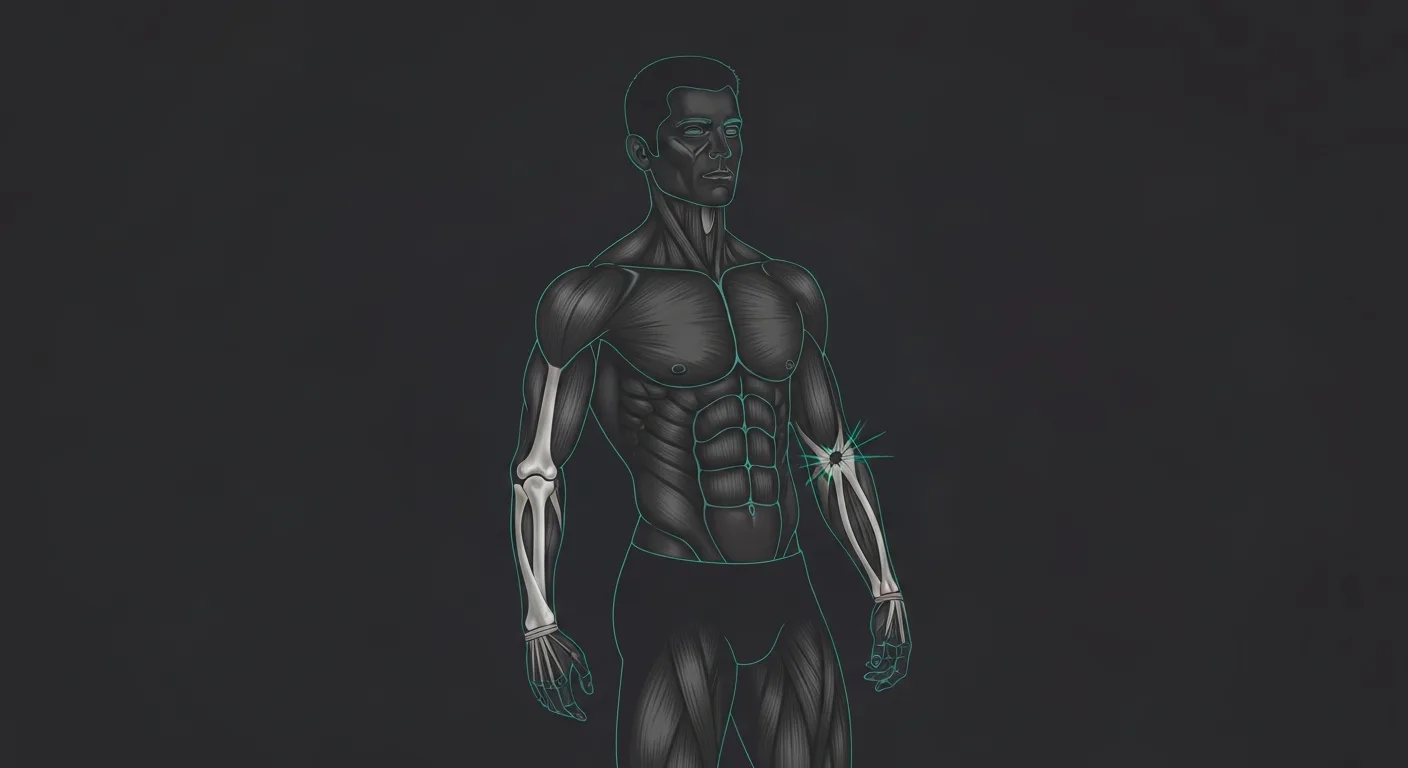
If you experience pain between the bicep and tricep, it may involve one of these nerves rather than the muscles themselves — the nerve pathways run through the intermuscular septum in this exact area.
Training Implications
Understanding arm anatomy helps you build a balanced, complete program:
- For arm size — prioritize the triceps (largest muscle) and brachialis (pushes the biceps outward). Don't neglect the forearms for proportional development.
- For pressing strength — the triceps is the prime mover in the lockout phase of bench press and overhead press. See tricep exercises for bench press for targeted work.
- For grip and forearm development — direct wrist curl, reverse curl, and farmer carry work develops the forearm compartments that regular bicep and tricep training neglects.
- For injury prevention — balance your pushing (tricep-dominant) and pulling (bicep-dominant) volumes. A significant imbalance can lead to elbow pain or shoulder issues from weak triceps.
For detailed exercise breakdowns, start with the best tricep exercises and work through the exercise guides for each movement pattern.